
Do You Need a Car in Okinawa? Driving vs Public Transport
- Iris

- 11 hours ago
- 7 min read
Okinawa is often described as a destination where every visitor needs a rental car. That is too simple. A car can turn a scattered northern itinerary into a practical road trip, yet the same car may remain in a Naha hotel garage while you use Yui Rail, walk through the city or leave from Tomari Port for a ferry excursion. The useful question is not whether cars are generally convenient. It is whether your own hotel bases, daily stop count, luggage and driver comfort make a car more valuable than the time, cost and responsibility it adds. This article is not a rental-company ranking. It is a framework for deciding which days need a car, which days should remain car-free, and when a coach tour, airport transfer, taxi or private driver is the better solution.

Do You Need a Car in Okinawa? Decide by Area, Group and Trip Length
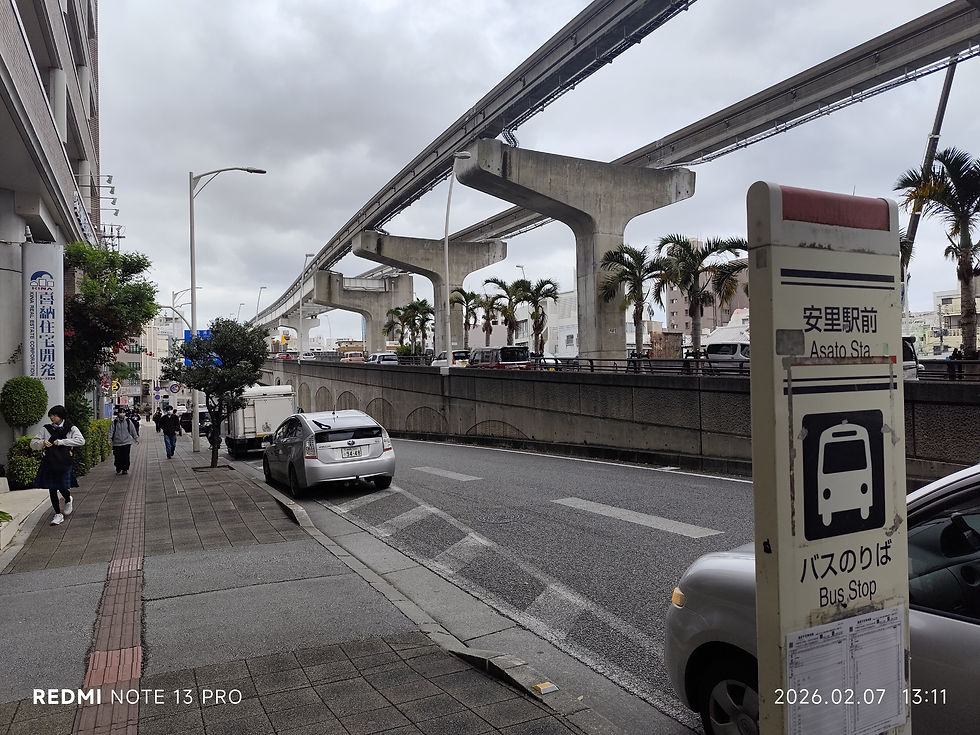
Naha-only trips normally do not need a car. Yui Rail connects Naha Airport with Asahibashi, Kenchomae, Miebashi, Makishi and the Shuri side of the city. Kokusai Street, Makishi Market, Tsuboya and Shuri work naturally with rail and walking, with buses or short taxi rides filling the remaining gaps. On a two- or three-night Naha stay, a rental often adds an airport shuttle, paperwork, hotel parking and time spent finding spaces near places that were already accessible without driving. Southern Okinawa depends on the number of stops. One fixed destination such as Senagajima or Gyokusendo can be handled by bus, transfer or organised tour. A one-day rental becomes more useful when the plan connects Itoman, Ojima, Chinen, coastal viewpoints and local food stops, particularly when weather may change the order. A departure-day drive must still finish with fuel, inspection, luggage unloading, a rental shuttle and airport check-in. Chatan does not automatically require a car. A hotel near American Village places restaurants, shopping and the waterfront within walking distance. Driving becomes more valuable when the same itinerary adds Yomitan, Zakimi, Cape Zanpa, Kaichu Road or several out-of-the-way restaurants. Onna depends on the resort and activity pickup. A traveller staying inside a resort, using airport limousine buses and joining activities with transfers can remain car-free. A traveller changing beaches, cafés, dive meeting points, Yomitan and Chatan every day will use a car much more. Returning from Onna to Naha every evening for dinner often removes the benefit of choosing a resort base. Churaumi Aquarium can be reached by express bus or coach tour. If it is the only major destination, a rental is optional. When the same day also includes Bise, Nakijin, Kouri Island, beaches and smaller restaurants, public-transport intervals reduce the time available at each stop. The value of driving is not that Churaumi is otherwise impossible; it is that several dispersed northern places become one workable day. Yanbaru and the far north usually favour self-driving or a private driver because forests, villages, trails and coastlines are not organised around frequent urban transit. With only one driver, sleeping in Nago, Motobu or the north is often safer than returning to Naha every night. Kerama, Tokashiki or Zamami ferry days usually leave a main-island rental parked. Miyakojima, Ishigaki and Iriomote are separate transport decisions and should be assessed through their own hotel locations, activity transfers and road networks. Solo travellers pay the full rental, parking and protection cost. For Naha or one northern highlight, buses, a tour and taxis usually make more sense. A car can still justify its price for sunrise photography, a remote Yanbaru stay or several small stops that timetables cannot support. Couples often benefit most from comparing a coach tour with a one- to three-day middle rental. On a four-day Naha-based trip with one northern day, a full rental is rarely necessary. On a five-day trip with two nights in Onna or Nago, a two- or three-day rental is usually the balanced choice. If only one person drives, count the navigation, parking and fatigue burden carried by that person. Three or four travellers can divide costs efficiently, but four seats do not guarantee space for four adults and four large suitcases. Choose the vehicle for the maximum return-day luggage load, not only the passenger count. Families gain flexibility from carrying a stroller, spare clothes and supplies and from being able to stop when a child sleeps or the weather changes. Japanese law requires an appropriate child restraint for children under six, so child seats, stroller space and luggage must be planned together. For older relatives, the important questions are waiting time, walking distance, step height, rest needs and who will drive. A private charter may be safer when one person would otherwise navigate, move luggage and provide care at the same time. Three days and two nights: remain car-free for a Naha trip and use an express bus or organised tour for one northern highlight. Four days and three nights: two Naha nights plus one northern excursion rarely requires four rental days; one Naha night followed by two Onna or Nago nights can justify collecting the car on the second morning. Five days and four nights: this is the strongest partial-rental format, with day one in Naha and driving on days two to four. Six or seven days do not automatically require a longer rental. Naha days, a Kerama boat day and resort downtime can remain car-free, while continuous hotel changes, Yanbaru and remote coastal stops support a full-trip rental.

Real Cost, Driving Risk and Four Practical Models
The real cost of driving is not the advertised daily rate. It includes the rental total, collision and NOC-related protection, fuel, expressway or ETC charges, parking, child seats, one-way or overtime fees, and the time used by collection and return. Official Toyota and ORIX examples commonly show NOC charges of ¥20,000 when a vehicle can be returned under its own power and ¥50,000 when it cannot. A collision-damage waiver does not necessarily remove NOC liability, and tyre, glass, towing, cleaning, lost-key or second-accident rules may be separate. Airport collection can involve baggage pickup, finding the shuttle stop, waiting for the bus, travelling to an off-airport office, queuing, document checks and fitting child seats. Travellers arriving in the afternoon or evening and sleeping in Naha are often better using Yui Rail first and collecting the vehicle the next morning. For an early departure, returning the car the previous evening and sleeping near the monorail can be more reliable than adding fuel, inspection and a shuttle to the flight morning. Traffic, alcohol, typhoons, heavy rain, luggage capacity and fatigue can reverse an otherwise sensible decision. The driver cannot drink. Strong wind, flooding, poor visibility and bridge or coastal-road restrictions may remove the advantages of a car. Vehicle size must be based on passengers plus the largest expected luggage load. One driver should not be given repeated northern returns, night roads and wet-weather driving simply because the rental has already been paid. Model one is three car-free days in Naha: Yui Rail, Kokusai Street, Makishi, Shuri, Tsuboya and a final airport transfer. Model two is a five-day partial rental: day one in Naha, collection on day two, Chatan or Yomitan on the way to Onna, then central Okinawa, Churaumi, Motobu or Kouri before returning the vehicle on the fourth evening or fifth day. Model three is a five-day family road trip: spend the first night in Naha after a late arrival, collect a larger vehicle the next morning, reserve child seats and move to Onna or Nago. The car's value is rest, weather flexibility and luggage capacity, not adding more attractions. Model four is four days without driving for a couple: a Naha city day, one organised northern tour and one Kerama or southern-transfer day, allowing both travellers to drink at dinner and avoid assigning one permanent driver. Common mistakes include renting for the whole trip merely because three or four people can divide the rate, driving to Onna or Nago immediately after a late flight, sleeping in Naha while making daily northern returns, comparing only the base rate, assuming a no-car trip means remaining on Kokusai Street, and forcing the original itinerary through severe rain or exhaustion because the vehicle has already been paid for. Driving-document rules depend on the country or territory that issued the licence. Eligible visitors may need an original booklet-style International Driving Permit under the 1949 Geneva Convention, while licences from Switzerland, Germany, France, Belgium, Monaco and Taiwan use the original licence with an authorised Japanese translation. A card or digital permit is not automatically valid in Japan. Every possible driver should present the required documents and be registered at pickup. A car is usually unnecessary for a short Naha trip. A coach tour can cover one representative northern day. A five-day trip with Naha at both ends and Onna or Nago in the middle is often best with a partial rental. Families, large luggage loads and several northern stops create the strongest case for driving. The best plan is not the one that uses a car most often; it is the one that assigns a car only to the days when it removes more friction than it creates. Drivers can compare Okinawa rental products and Booking.com or Expedia accommodation. Car-free travellers can compare airport transfers, coach tours, private charters and Naha hotels.

Related reading
More Okinawa guides
Choose your base in Naha, Chatan, Onna, Nago or Motobu, build the route with the five-day self-drive itinerary, and check the complete five-day Okinawa budget


Comments