
Kagoshima Chuo or Tenmonkan? Pick Your Base by Trains, Luggage and Evenings
- Iris

- 2 days ago
- 4 min read
At 6:30 in the morning, Kagoshima Chuo feels like the obvious place to stay: Shinkansen platforms, JR trains and airport buses are concentrated around one transport hub. At 9:30 at night, Tenmonkan makes a stronger case. Its covered arcades, restaurants and bars let dinner spill naturally into the evening without turning the trip back to the hotel into one more calculation. The two areas are only about seven minutes apart by tram or bus, yet that short ride matters differently when you have a full-size suitcase, an early departure or two nights of late dinners.
Kagoshima Chuo or Tenmonkan: decide by the edges of your day
Kagoshima Chuo or Tenmonkan is less a question of which district has more sights and more a question of where you want friction to disappear. Chuo is the transport-first base. It works especially well when Kagoshima is one stop in a longer Kyushu trip, when you arrive by Shinkansen from Fukuoka or Kumamoto, or when the next morning sends you toward Ibusuki or another JR connection. You can get off the train, leave luggage near the station and keep the hotel move compact.
Tenmonkan is the evening-first base. Kagoshima City’s official tourism information describes it as the city’s main downtown shopping and entertainment district. Restaurants, shops and the covered shopping streets sit close together, so the useful part of the location shows up after sightseeing hours rather than at check-in. That makes it attractive for travelers who want to eat late, browse after dinner or return to their room on foot once the tram stops feeling worth the effort.
The station wins on transfer days, especially with a large suitcase
The airport limousine bus currently takes about 40 minutes from Kagoshima Airport to Kagoshima Chuo, with service roughly every 20 minutes and an adult fare of ¥1,500. Tenmonkan also has direct airport-bus service, with the city tourism site giving a journey of about 50 minutes, so choosing Tenmonkan does not automatically mean changing vehicles at Chuo. The advantage of the station appears when several transport tasks stack together: airport arrival, JR travel, luggage storage and an early train on the same stay.
There is also a specific accessibility consideration. Since October 2025, Kagoshima Airport has operated a reservation-required limousine bus fitted with a wheelchair lift on one round trip. The airport’s current notice says that this special lift-equipped service stops at Kagoshima Chuo in the city but not at Tenmonkan, City Hall or the high-speed ferry terminal. For a traveler who needs that lift, Chuo is not just marginally easier; it removes another transfer.


Kagoshima Chuo Station platform and Ibusuki no Tamatebako. Photo: そらみみ (Soramimi) / Wikimedia Commons, CC BY-SA 4.0.
Tenmonkan earns its room rate after dinner
The strongest reason to book Tenmonkan is not that it saves a dramatic amount of sightseeing time. It is that it changes how the evening feels. After black-pork dishes, ramen or a drink, a hotel near the arcades means you can simply walk back rather than check a tram stop for a short ride to the station. Some of the shopping streets are covered, which is a small but useful advantage during a summer shower or a windy winter evening.
Chuo still has plenty of practical evening infrastructure around AMU PLAZA and the station, including restaurants, shops and convenience stores. It is not a dead zone after dark. Tenmonkan simply spreads the choice of eating and late-evening wandering over a denser downtown area. Travelers who tend to finish dinner early may barely notice that advantage; people who like the city after 8 p.m. often will.
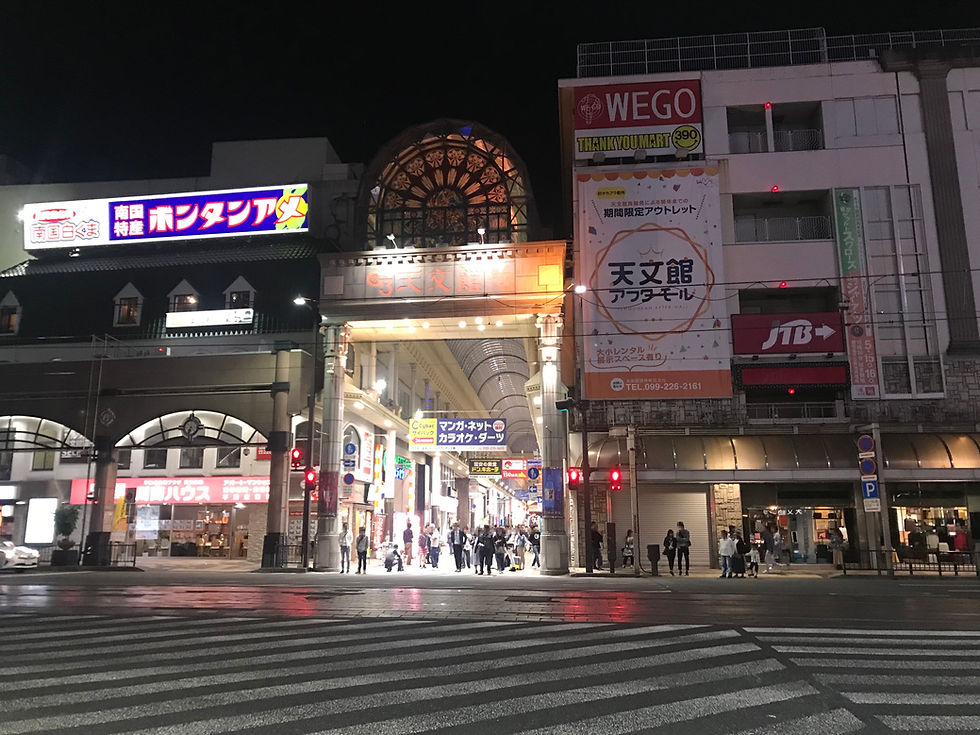
Tenmonkan G3 shopping arcade at night. Photo: そらみみ (Soramimi) / Wikimedia Commons, CC BY-SA 4.0.
Related guides
If your next decision is whether to sleep in the city or continue south for the sand baths, read Kagoshima or Ibusuki: Where to Stay for One Night Without a Car. That guide handles a different decision: city base versus onsen town, rather than which Kagoshima City neighborhood to use.
For Sakurajima, do not let the ferry decide the hotel by itself
Sakurajima Ferry takes about 15 minutes between Kagoshima Port and Sakurajima, with daytime departures roughly every 20 minutes. From Kagoshima Chuo, the city’s route information puts the trip at about 15 minutes by tram to Suizokukan-guchi plus an eight-minute walk to the ferry area. Tenmonkan sits farther east and closer to the waterfront, but the saving is not large enough to make it the automatic hotel choice for a single Sakurajima day.
Look at what surrounds the ferry day instead. Arriving by Shinkansen the night before, leaving a suitcase near the station and heading out with a day bag still makes Chuo efficient. Spending the whole day around central Kagoshima, returning from Sakurajima before dinner and wanting the evening on foot makes Tenmonkan feel better. Both bases keep the ferry entirely workable.
Two nights rarely justify changing hotels between the two districts
Because Chuo and Tenmonkan are only a short tram ride apart, moving hotels after one night usually creates more work than it removes. Check-out, luggage storage, collection and a second check-in cost more time than the few daily tram stops you save. A split stay makes sense only when the conditions change sharply—for example, a very late first arrival at Chuo followed by a longer city stay with no further JR use. For a normal two-night visit, one base is cleaner.
Stay both nights at Kagoshima Chuo when the trip is transport-heavy: Shinkansen in and out, large luggage, an early final morning, or Kagoshima as one link in a longer Kyushu route. Stay both nights in Tenmonkan when restaurants and downtown evenings are part of the reason you are in the city, and you are comfortable using a tram to reach Chuo when required. The hotel itself can then be chosen within that district by room size, breakfast, bath facilities and cancellation terms rather than forcing a neighborhood compromise.
More to read
Kagoshima Chuo makes arrival and departure lighter; Tenmonkan lets the city linger later into the night. The fastest way to choose is to look at your first evening and your final morning. Whichever one contains the harder constraint is usually where the hotel should go.


Comments