
Kawaguchiko to Oishi Park: When the New 15-Minute Boat Beats the Red-Line Bus
- Iris

- 2 days ago
- 4 min read
The headline sounds almost too simple: a new boat now crosses from Funatsu Pier to Oishi Park in about 15 minutes. For a car-free Lake Kawaguchi trip, that looks like an obvious replacement for the Red-Line sightseeing bus—until you look at where the journey actually starts.
Funatsu Pier is not Kawaguchiko Station. It is roughly a 10-minute walk from the station, while the Red-Line bus leaves from the station and runs directly to Kawaguchiko Natural Living Center beside Oishi Park. Kawaguchiko to Oishi Park is therefore not simply “15 minutes by boat versus about 30 minutes by bus.” The useful comparison is the whole door-to-door route, plus what else you plan to do around the lake.
Kawaguchiko to Oishi Park is not a 15-minute station-to-park trip
If you step off a train or highway bus with luggage, the Red Line has the cleaner geometry: board at the station and stay seated until the north shore. The sightseeing bus takes roughly half an hour to Natural Living Center. With the boat, the walk to Funatsu Pier comes first and the 15-minute crossing starts only after that.
The calculation changes if you are already around Funatsuhama, the Mount Fuji Panoramic Ropeway or the southern lakeshore. In that case, walking to the pier can fit naturally into the morning, and the boat becomes a direct continuation of the day rather than an extra transfer.

The boat makes sense when the lake crossing is part of the visit
The Oishi Park Line began service on July 17, 2026. A one-way ride costs ¥1,000 for adults and ¥500 for elementary-school children, with an advertised crossing time of about 15 minutes. The operator presents it as a year-round access option, but high winds, poor weather or operational conditions can still suspend sailings.
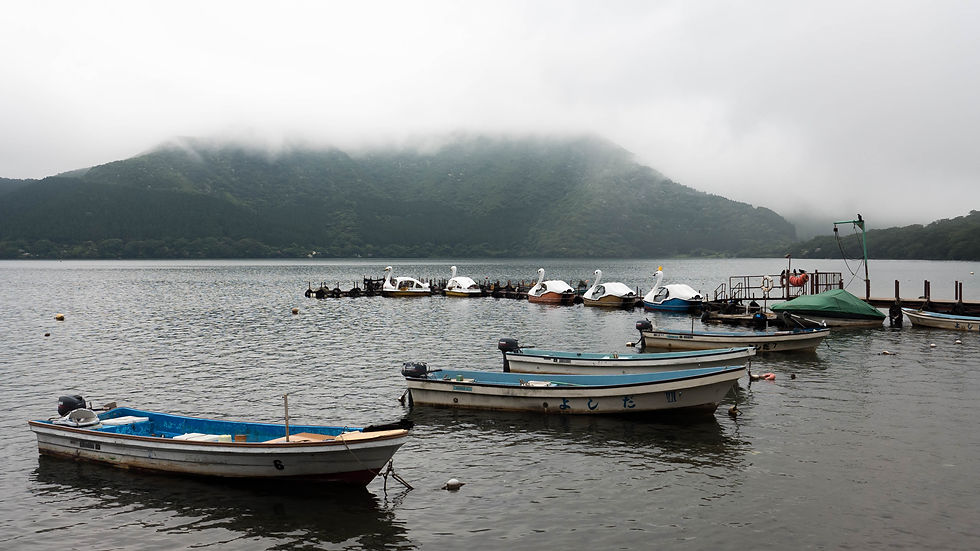
That weather dependence is also the point of the boat. On a clear day, the lake crossing turns a transport leg into part of the sightseeing. The covered cabin gives you somewhere to sit out of direct sun or light rain, and the operator says strollers and wheelchairs can board, with barrier-free space inside. The land approaches still matter, though, especially for anyone handling a large suitcase or travelling with limited mobility.
The Red-Line bus wins when Oishi Park is one stop in a bigger day
The Red Line becomes much stronger when Oishi Park is only one stop in a larger lake day. Current common sightseeing-bus passes cost ¥1,500 for an adult and ¥750 for a child for one day, or ¥2,000 and ¥1,000 respectively for two days. If you are hopping between several lakeside stops, the pass can simplify both cost and decision-making.
For a simple out-and-back trip to Oishi Park, a pass is not automatically necessary. The bus also accepts transport IC cards such as Suica and PASMO, so it is worth building the fare choice around the whole day rather than buying a pass just because it exists. Road traffic and busy stops can slow the Red Line, but the bus is not dependent on lake conditions in the way the shuttle is.
Pair this with
Last departures matter more than the headline journey time
The last departure can matter more than the headline journey time. Under the summer schedule, the Oishi Park side runs until about 4:50 p.m. and the Funatsu side until 5:15 p.m.; regular and winter periods finish earlier. Special-event days can change that sharply. For the Lake Kawaguchi Festival on August 5, 2026, the operator has already announced an earlier last departure of 2:50 p.m. from Oishi Park and 3:15 p.m. from Funatsu.
That makes the boat a better fit for an earlier crossing than for a late, open-ended afternoon. If you want to wait for softer evening light at Oishi Park or linger over food, check the Red-Line return timetable for your date before committing to the boat. There is no requirement to use the same mode both ways.
Four trip profiles make the choice clearer
Starting at Kawaguchiko Station with luggage: take the Red Line unless the lake crossing itself is a priority. Already sightseeing around Funatsu and travelling in settled weather: the boat earns its place because the transfer doubles as a lake experience. Planning several Red-Line stops: the bus pass is usually the more coherent tool. Returning late or travelling in uncertain weather: keep the bus as the main plan and treat the boat as the optional upgrade.
A mixed outbound and return route can be the cleanest plan
Oishi Park itself is free to enter, with the north-shore view, flower areas and Kawaguchiko Natural Living Center concentrated in the same zone. A mixed route can make the geography feel much less repetitive: walk from Kawaguchiko Station to Funatsu Pier, cross the lake by boat, then return from Natural Living Center by Red-Line bus.
Lake Kawaguchi weather can change the Mount Fuji view within the same day. Keeping both routes in play is more useful than treating the new boat as a universal replacement. What changed in 2026 is the shape of the decision: car-free travellers can now choose between following the shoreline road and cutting straight across the water.


Comments