
Tokyo Koenji Awa Odori 2026: How to Watch the 1-Million-Visitor Street Festival
- Iris

- 3 days ago
- 6 min read
Koenji does not feel like a venue that happens to host a festival. For two evenings, the everyday shopping streets become the venue itself. Drums echo between low buildings, dance groups move through the avenues instead of staying on a fixed stage, and spectators keep adjusting their position as the procession shifts. Tokyo Koenji Awa Odori 2026 runs on August 29 and 30 from 5:00 p.m. to 8:00 p.m. The organizer lists last year’s figures as 158 participating groups and roughly 1.02 million spectators over the two days, which is the clearest clue that route choice matters almost as much as arrival time.
The main action spreads between JR Koenji Station and Tokyo Metro Shin-Koenji Station across eight street performance areas. You can watch from the street for free, support the event through special reserved viewing seats, or add one of the daytime indoor stage performances before the outdoor dancing begins. The useful question is less about collecting venues and more about where you want to be when the crowd becomes dense, and which station will still make sense when you leave.
What Tokyo Koenji Awa Odori 2026 looks like on the ground
The 2026 street festival takes place on Saturday, August 29 and Sunday, August 30, with outdoor dancing from 5:00 p.m. to 8:00 p.m. Vehicle restrictions begin earlier, from 4:10 p.m. until 8:30 p.m., across a broad section of Koenji south and north of the station. Driving into the core area is therefore a poor fit for the event. The eight official performance areas are Chuo, Higashi, Junjo, Pal, Momozono, Minami, Look Dai-ichi and Look Dai-ni. They are not eight sealed stages with identical shows: dance groups move through scheduled routes, so street width, shopfronts and intersections change the atmosphere.
Station-side sections are easy to understand and easy to exit, but they naturally attract heavy foot traffic. Deeper inside the shopping streets, buildings sit closer to the action and the music can feel more immersive, while walking space becomes tighter. One main viewing area plus a slow walk through a second part of the route usually gives a better sense of the festival than trying to complete all eight zones in three hours.
The daytime stages change the shape of the day
Koenji does not wait until 5:00 p.m. to start dancing. The organizer has announced daytime stage performances at Za-Koenji and Sesion Suginami on both festival days, with sessions beginning at 11:30 a.m. and 2:00 p.m. A seated theatre makes it easier to see formations, costumes, instruments and choreography; the evening streets offer the opposite experience, with sound bouncing off shopfronts, groups passing close by and spectators becoming part of the visual field. Combining one daytime stage with one or two street sections creates a natural break for lunch, drinks and a bathroom stop before the streets become substantially busier.
The train detail that can derail an otherwise simple trip
Koenji is normally straightforward from Shinjuku, but the festival weekend has one important exception: JR Chuo Line rapid trains do not stop at Koenji on August 29 or 30. From Shinjuku or central Tokyo, you can take a rapid train to Nakano and change to the Chuo-Sobu local service, or use the Tokyo Metro Marunouchi Line directly to Shin-Koenji. From the western suburbs, the official access guide suggests changing at Mitaka to a local service, or reaching Ogikubo and continuing by Marunouchi Line.
This matters even more after the event. Koenji Station is the obvious exit if you finish on the north side, but the organizer also lists Shin-Koenji at roughly five minutes from the festival area, Higashi-Koenji about 12 minutes, Asagaya and Nakano about 15 minutes, and Minami-Asagaya about 20 minutes. A slightly longer walk can be more comfortable than turning against the densest flow toward a single gate.
Reserved seats are really about certainty, not a different show
Street viewing is free, while special viewing seats are offered as a benefit for supporters of the festival. For 2026, a contribution of ¥15,000 per person corresponds to a seat at the Chuo performance area. A ¥10,000 contribution can provide a seat at Junjo, Momozono or Minami, subject to availability. The organizer accepts online applications until the day before the event unless allocations fill earlier. The main value is certainty: a fixed place, less time searching for a gap in the crowd and a more manageable option for older travellers or anyone who dislikes standing for long periods.
There is one important condition. The contribution is treated as a donation, and the organizer states that it is not refunded if the event is cancelled because of rain or similar circumstances. A reserved seat is therefore a comfort choice rather than a risk-free ticket purchase.
The hour before 5:00 p.m. is more useful than it looks
Before the dancing begins, Koenji still behaves more like a neighbourhood. It is easier to buy a drink, eat something, locate bathrooms and understand which side of the station you are on. As 5:00 p.m. approaches, road restrictions, spectators and performance movement divide the area into slower-moving pockets. The official FAQ prohibits taping off space on the roadway in advance and asks spectators not to obstruct businesses, so this is not a fireworks event where a mat can reserve your place for hours.
Large rubbish bins are placed at general information points, although the organizer’s basic rule is to take rubbish home or return it to the shop where you bought the food. Carrying a small bag for wrappers and empty bottles becomes surprisingly useful once the streets fill.
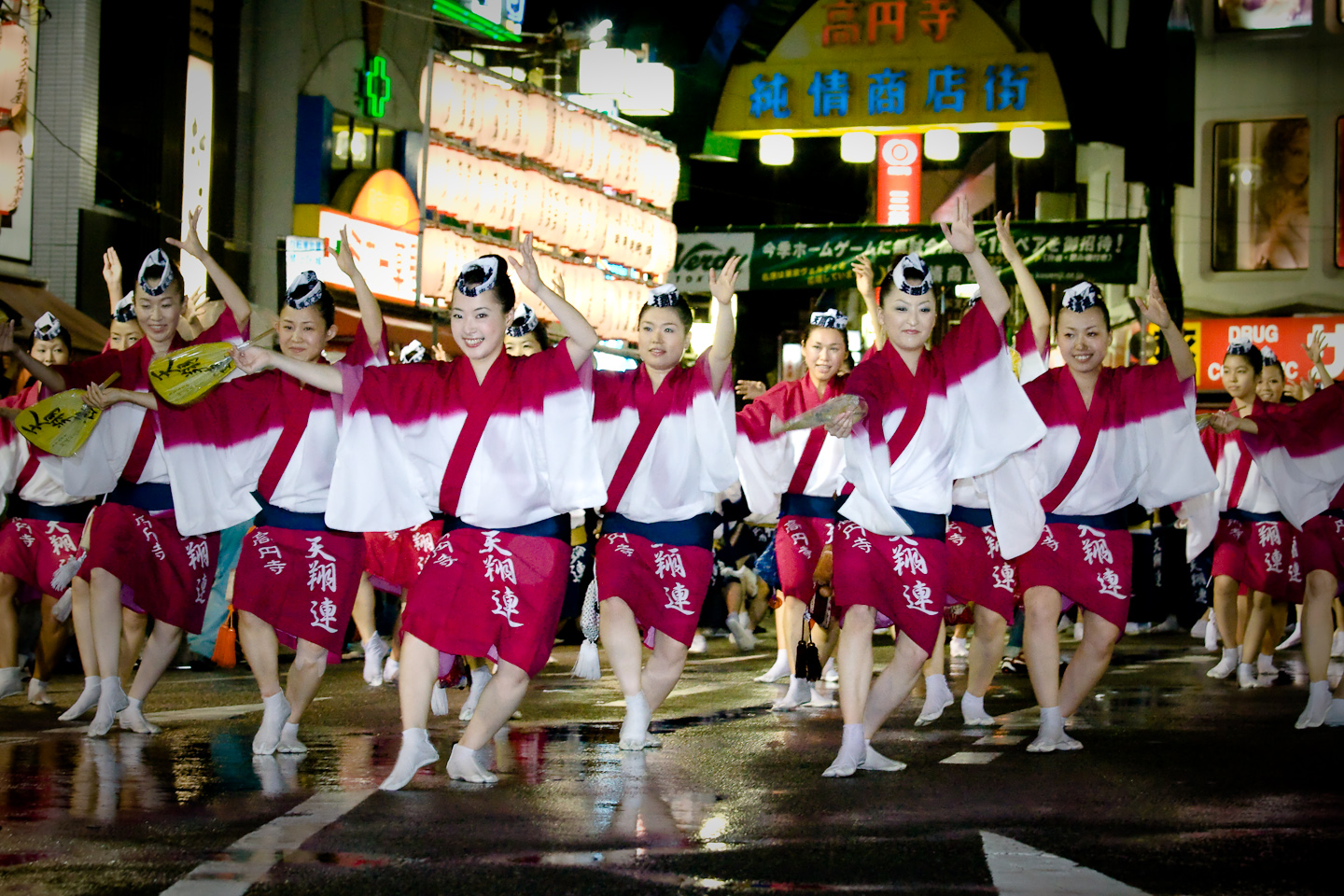
Street-level viewing also changes photography. Once the front rows stand, a technically good spot can become a wall of heads, fans and raised phones. A position near a slightly wider intersection often gives cleaner sightlines than constantly chasing a group through the route. Stay outside the performance space: the official rules do not allow spectators to jump into a participating group during the main event.
Last year’s one-million-person figure is a warning about overplanning
The official 2025 figures — around 1.02 million spectators across two days — are useful not because they predict the exact density of every 2026 street, but because they show how unrealistic normal walking-time assumptions can become. A plan that tries to fit three performance areas, two famous restaurants, several photo spots and shopping between 5:00 and 8:00 p.m. will spend too much of the evening in transit. A more flexible rhythm is to eat before the core crowds form, settle near a preferred area around 4:00 p.m., watch one or two sections after 5:00, drift through part of the shopping streets, then decide around 7:30 whether to stay for the final dances or start moving toward a less congested station.
The comparison works well because Tokushima and Koenji present the same dance tradition in very different urban settings. Tokushima feels built around the festival; Koenji feels like an ordinary Tokyo neighbourhood temporarily surrendering its streets to the festival.
Rain, luggage and bathrooms become bigger issues after the crowd arrives
Anyone considering the special viewing seats should note the organizer’s no-refund policy for weather-related cancellation. Outdoor performance conditions can still change, so the official site is the place to recheck in the final days. Large luggage is a bad match for the narrowest shopping streets; if you are changing hotels or arriving from another city, leaving bags at your accommodation or using storage at a larger station will make the evening substantially easier. Bathrooms are another reason not to wait until peak density, when a short map distance can become a long walk against the flow.
The neighbourhood is what makes Koenji different
Koenji is known on normal days for vintage clothing, small bars, live houses and residential streets. During Awa Odori, those same signs and storefronts remain in place while drums, flutes, fans and lines of dancers take over the foreground. The city does not build a separate festival world; it temporarily changes how familiar streets are used. That is the strongest reason to choose Koenji over a generic summer event in a large park: the performance and the neighbourhood stay visible at the same time.
For final checks before travel, use the official Tokyo Koenji Awa Odori site, the 2026 traffic restriction information and the official festival FAQ. Participating groups, route tables, booths and operational notices may still be updated closer to the weekend.


