
Akita Kanto 2026 Reserved Seats: Are S, A or B Seats Worth It vs Free Viewing?
- Iris

- 3 days ago
- 5 min read
Akita Kanto reserved seats are not a shortcut to a different show. They are a way to remove one of the night’s biggest uncertainties: whether you can sit down in a usable position without spending the early evening hunting for roadside space. For 2026, S seats cost ¥4,500, A seats ¥4,000 and B seats ¥3,500, while a six-person box costs ¥28,000. The decision is therefore less about premium access and more about how much certainty matters to your group.
Free roadside viewing keeps your budget and movement flexible, but gives up the guarantee of a chair and a fixed sightline. That makes it attractive for solo travellers, people who only want one or two performance rounds, and visitors comfortable adapting to crowd conditions. The existing general festival guide explains that both paid and free viewing exist; this page answers the narrower question of when paying an extra ¥3,500–¥4,500 actually changes the experience.
Akita Kanto reserved seats: what ¥3,500–¥4,500 actually buys
The official paid sections sit around the central median of the roughly 800-metre Kanto Odori night venue. Seats are arranged back-to-back and face the performance lanes. S seats are tiered seats on the central roadway wall; A can mean other tiered seating or a pipe chair; B uses bench seating. The organiser does not allow buyers to select an exact seat location, so paying for S means choosing a seat class, not choosing a particular lantern pole or camera angle.
Spectator entry begins at 18:35. On August 3 and 6, Kanto entry starts at 18:45 and performance at 19:10; on August 4 and 5 those times are 18:50 and 19:15. The night ends around 21:00, with road restrictions lasting until 21:30. If you already intend to watch the full evening, a reserved seat turns arrival time from a positioning problem into a simpler check-in problem.
S, A and B differ by more than ¥1,000
S is the clearest choice for travellers who care most about tiered seating and reducing the chance of another spectator sitting directly in front at the same level. A is the middle-price option, but its seat type is less uniform because it can be either tiered seating or a pipe chair. B is the budget paid option: a bench solves the standing problem without promising the same seating format. The six-person box works out at roughly ¥4,667 per person when full, but supply is extremely limited and it is not the default choice for couples or solo travellers.
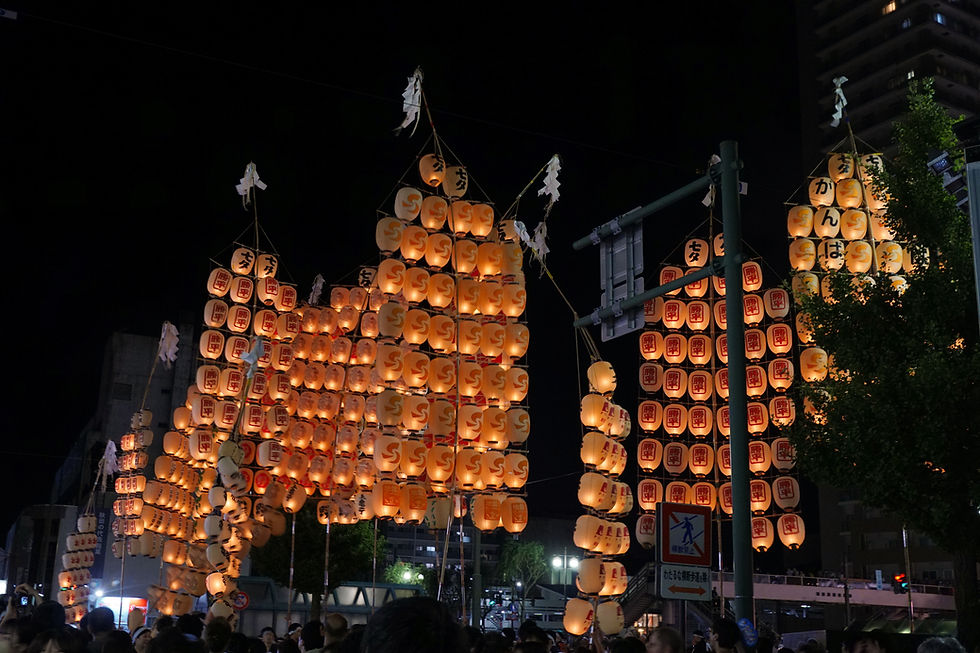
Festival scene: Akita Kanto 2023. Photo by 掬茶 via Wikimedia Commons, CC BY-SA 4.0.
Free roadside viewing buys flexibility, not a guaranteed ‘best free spot’
Free viewing is strongest when you are happy to stand, move and accept that the front-row situation will change with the crowd. Kanto Odori is a long performance corridor rather than one single stage. Public roadside space can be useful, but no 2026 official map designates one universal ‘best free position’. That is why a sensible free-viewing plan stays inside legal public viewing areas and follows staff instructions rather than treating private property, shop frontage, emergency access or restricted road space as a viewing hack.
Recent Japanese visitor reports reinforce that the paid-seat advantage is certainty rather than exclusivity. A first-time visitor in 2025 documented buying a same-day paid seat and the view from it, while a long 2024 field recording shows the night performance unfolding over several rounds. Those experiences support the practical split between staying seated for a complete programme and moving more freely along the roadside; they do not prove that one free section is permanently superior.

Pair this with
Who gets real value from a seat — and who can save the money
I would prioritise a reserved seat for older travellers, families with children who tire easily, anyone who cannot comfortably stand for a long outdoor event, and first-time visitors with only one festival night. Wheelchair users have a separate official viewing arrangement and should not rely on the normal online booking flow; the organiser directs those applications to its reservation desk by counter, phone or fax.
Free viewing makes more sense for a fit solo traveller, someone planning to watch only part of the programme, or a visitor who values movement more than sitting. Photographers should also resist assuming the most expensive ticket automatically creates the best composition: exact seat positions cannot be chosen, so a paid seat solves comfort and positioning uncertainty rather than guaranteeing a unique photographic angle. Use the Tohoku summer festival itinerary to decide whether Akita should be your one seated festival night or a flexible stop between cities.
The rain rule changes the value calculation more than the ¥1,000 seat gap
The 2026 individual-seat rules are unusually important here: payment is non-cancellable, and the organiser states that tickets are not refunded even when rain causes cancellation. That means weather risk belongs in the purchase decision. A traveller with only one possible festival night is accepting more than a ticket price; free roadside viewing has no sunk ticket cost if weather or programme changes make a shorter visit sensible.

August 3 and 6 add a drone show — but that alone does not justify S seats
A new drone show is scheduled at about 20:35 on August 3 and 6, after the interaction period; August 4 and 5 do not list it. That gives the first and final nights an extra element, but the organiser does not advertise any seat class as the guaranteed best drone viewpoint. If you already want a full seated evening, August 3 or 6 gives you more programmed content. If your priority is the Kanto balancing performance itself, choose paid versus free on comfort and flexibility first.
The useful rule: pay to guarantee sitting, not to guarantee the ‘best view’
S, A and B seats are valuable when sitting down for the full programme materially changes whether your group can enjoy the night. Free viewing is valuable when you would rather keep your timing, location and budget flexible. The paid ticket is not a promise of a perfect sightline, especially because exact seat assignment cannot be selected. Before travelling, recheck official seat availability, weather notices and the current traffic-control map.


Comments