Fukuoka Local’s Route 210 Road Trip: 6 Hidden Stops to Yufuin (Shrines, Views & Anime Spots)
- Cody Tse
- Dec 21, 2025
- 6 min read

Whenever friends come to Fukuoka to visit me, they rent a car to drive to Yufuin—and the first thing they do is set the GPS to the Oita Expressway.When I see that, I usually say: “You’re missing the real treasure.”

As someone who’s settled in Fukuoka, I spend my days off exploring the prefectural borders. And honestly, compared to a predictable expressway drive, National Route 210, stretching across Fukuoka and Oita, is where Kyushu’s scenery really shines.
I’ve “conquered” this route the slow way—on foot and by bicycle (my legs still tremble when I think about it). That’s why I know it better than any guidebook: which bend has the best view, and which deep mountain detour hides a true secret spot.
If you’re doing this trip by car, congratulations—you can enjoy the same route in the most comfortable way possible. Follow my private map and turn your drive into a real road trip.
Quick Navigation
The Route Concept: Fukuoka to Yufuin the Scenic Way
Route idea: This drive follows the Chikugo River, traveling from Kurume/Ukiha (Fukuoka) through Hita/Kusu (Oita), and finally reaching Yufuin.
Time management: There are too many worthwhile stops here.If you’re thinking of doing all of them in one day—I strongly recommend you drop that idea.
Deep-travel plan: Stay one night in Hita City (I genuinely recommend this).
Direct-to-Yufuin plan: Choose 2–3 stops that fit your schedule.
Rental car note: Some sections are narrow (especially near Iwaya Shrine). When renting a car in Japan, I strongly suggest adding NOC coverage (liability waiver/insurance). Safety first—especially on rural mountain roads.
Stop 1: Ukiha Inari Shrine (Ukiha Inari)
“Fukuoka’s backyard—and there’s a reason it’s exploded on Instagram.”

Leaving Fukuoka City and entering Ukiha, you’ll notice it’s a fruit-growing region—but today we’re here for scenery.
You’ve probably seen photos of endless red torii gates online. Seeing it in person is even more striking. You’ll need to climb a bit (drivers can park higher up near the mid-slope parking area—much easier than what I did back when I arrived by bike). From the top, look back:
A straight line of vivid red torii gates cuts cleanly into the cityscape of the Chikugo Plain below.
On a clear day, the view is breathtaking—like the boundary between the “sacred” and the “everyday world” disappears.
Local tip: After photos, Ukiha has excellent cafés and bakeries. Grab snacks for the drive—your future self will thank you.
Stop 2: Kora Taisha Shrine (Kora Taisha)
“Kurume’s landmark—great at night for city lights, unbeatable in daylight too.”

If you’re coming from the Kurume side, this is practically on the route. Kora Taisha sits at the top of Mt. Kora. I once biked up here and it felt like a training camp from hell—but by car it only takes a few minutes.
In front of the main shrine building, there’s a viewpoint where you can see the entire Kurume city area and the winding Chikugo River.
Insider note: Every year in August, the shrine hosts a lantern event (Dedication Lantern Festival). The approach lights up with lanterns. If you visit in summer, come in the evening—the atmosphere is excellent.
Stop 3: Hita City (Hita) — Attack on Titan Pilgrimage
“That day, humanity remembered the fear of being dominated by Titans…”

Cross the prefectural border into Hita City (Oita)—one of my favorite places to visit on a normal day off. It’s also the hometown of Hajime Isayama, the creator of Attack on Titan. For anime fans, Hita is basically sacred ground.
Absolute must: Oyama Dam (Oyama Dam)

This is non-negotiable. You’ll find bronze statues of Eren, Mikasa, and Armin from their youth.
Stand beside them, then look up at the towering dam wall behind—the sense of pressure is real. The scene captures that “Volume 1” feeling of awe, dread, and impact almost too perfectly.
Bonus stops for fans
Levi statue near Hita Station
Roadside Station Mizube no Sato Oyama (includes an illustration/original art museum)
If you’re a serious fan, reserving half a day here is absolutely worth it.
Midway Break: Why Not Stay One Night in Hita?
By the time you reach Hita, it’s usually already well into the day. If you don’t want to drive mountain roads in the dark to reach Yufuin, I strongly suggest staying in Hita for one night.
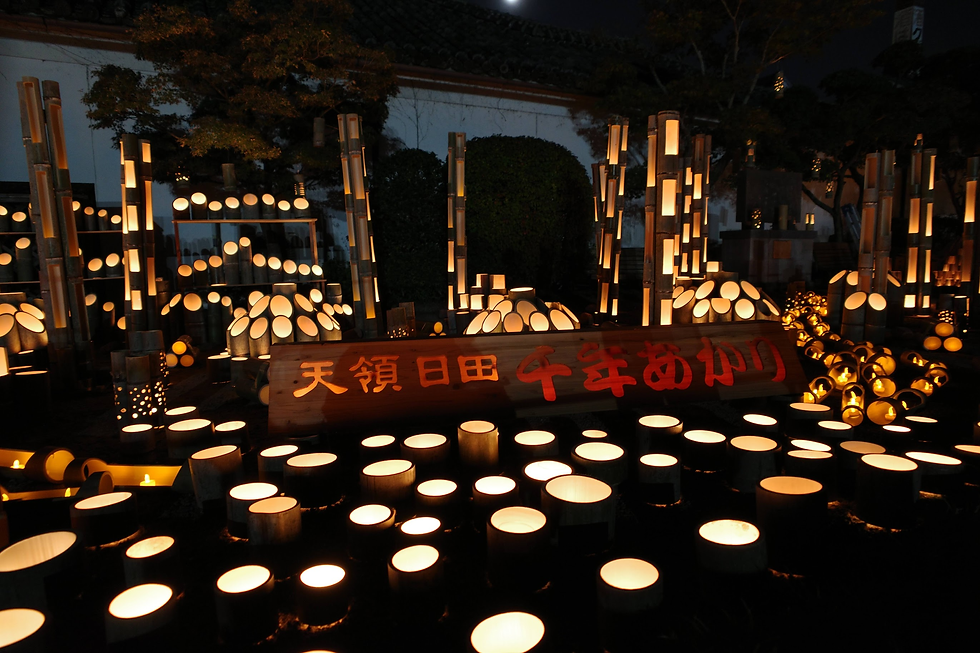
Hita is often called “Kyushu’s Little Kyoto.” At night, Mameda-machi is quiet and beautiful—completely different from Yufuin’s tourist-heavy mood. And in November, Hita also hosts the Sennen Akari (Thousand-Year Lantern Festival) I introduced before.
Related read: Kyushu’s Autumn Limited Event: Hita “Sennen Akari” — 30,000 Candlelights and a Deeper Japan Than Yufuin
Stop 4: Iwaya Shrine (Iwaya Shrine)
“A true mountain sanctuary with almost no tourists—this is the real hidden gem.”

This is one of my personal secret picks, deep in the mountains near the Fukuoka–Oita border (Toho Village). Most visitors never come here.

The main shrine hall is literally embedded into a massive rock formation (Gongen Rock). Walking the approach path, you’re surrounded by towering old trees, and the silence is so deep you mainly hear the wind.
It feels sacred, mysterious—like stepping into a barrier zone.
⚠️ Critical navigation warning
On Google Maps, search “Iwaya Shrine (Toho Village)” specifically.Japan has multiple “Iwaya Shrine” locations (including in Nagasaki and Kyoto). Don’t accidentally route yourself to the wrong prefecture.
Driving note
The road gets narrow. Cycling is easy; driving requires careful attention. This is exactly why I recommend getting solid rental insurance/NOC coverage.
Stop 5: Kozuka Atago Jizo (Kozuka Atago Jizoson)
“A mountain of wish papers—maximum visual impact.”

If you enjoy cultural exploration, come here. This is a deeply respected spiritual site among locals.
What left the strongest impression on me: behind the Jizo statue, there are countless white wish papers, packed densely across the surface. From a distance, it’s almost overwhelming—so many wishes layered together that it can even trigger mild trypophobia.
Each paper is one person’s desire. You can genuinely feel the intensity of belief in the air.
Stop 6: Bungo Mori Roundhouse Park (Bungo Mori Kikanko Park)
“Looking for the ‘door’ from Suzume.”

This is your last stop before Yufuin, in Kusu Town. It’s the only existing fan-shaped roundhouse in Kyushu.
Rusty tracks, weathered concrete walls, abandoned steam locomotives—everything here has a distinct ruin aesthetic. Makoto Shinkai’s film Suzume draws inspiration from places like this: forgotten structures that feel like they hide stories. Unfortunately, the weather was awful when I visited, so I didn’t get many photos.
Photography tip: Go near sunset. When the light streams through broken windows into the roundhouse, even phone photos can look like a movie poster.
Final Thoughts: The Best Scenery Is on the Road (Fukuoka → Yufuin)
After Bungo Mori, it’s about a 30-minute drive to Yufuin.
Yes—this route can take 2–3 hours longer than the expressway.But you gain something the highway can’t offer:
the oppressive scale of Titans at the dam
ruin-lit sunset shots by old locomotives
a river valley and mountain road that actually feels like Kyushu
and that long, vivid stretch of red torii gates
If you’re already in Kyushu and you have a car, don’t waste that freedom.Pull over when the view hits. That’s the real charm of driving here.
Read More: