
Is the Yokohama Sea Bass Worth It? When the Harbour Boat Beats Another Train Transfer
- Iris

- 2 days ago
- 3 min read
Yokohama Station still feels like a major city interchange when you reach Bay Quarter. A few minutes after departure, the Sea Bass has replaced platforms and underground corridors with harbour water, bridge structures and the Minato Mirai skyline. That abrupt change is the strongest case for the boat: it turns a transfer into part of the visit rather than merely moving you between attractions.
The scheduled water bus currently links Yokohama Station East Exit, Yokohama Hammerhead, Pier Aka Renga and Yamashita Park. It is not usually the cheapest option, and it is not frequent enough to be treated like a metro line. It becomes useful when it removes an awkward rail connection, protects tired legs or places the harbour view exactly where the day needs a pause.
The Yokohama Sea Bass works best as an arrival route from Yokohama Station
The current adult fare from Yokohama Station is ¥1,300 to Hammerhead or Red Brick Warehouse and ¥1,500 to Yamashita Park. Rail is cheaper, but the comparison is not only ticket against ticket. A train journey may involve reaching the correct platform, changing lines and walking back from Bashamichi or Motomachi-Chukagai to the waterfront. With a child, a suitcase or a first afternoon in the city, the boat can remove the least enjoyable part of that sequence.
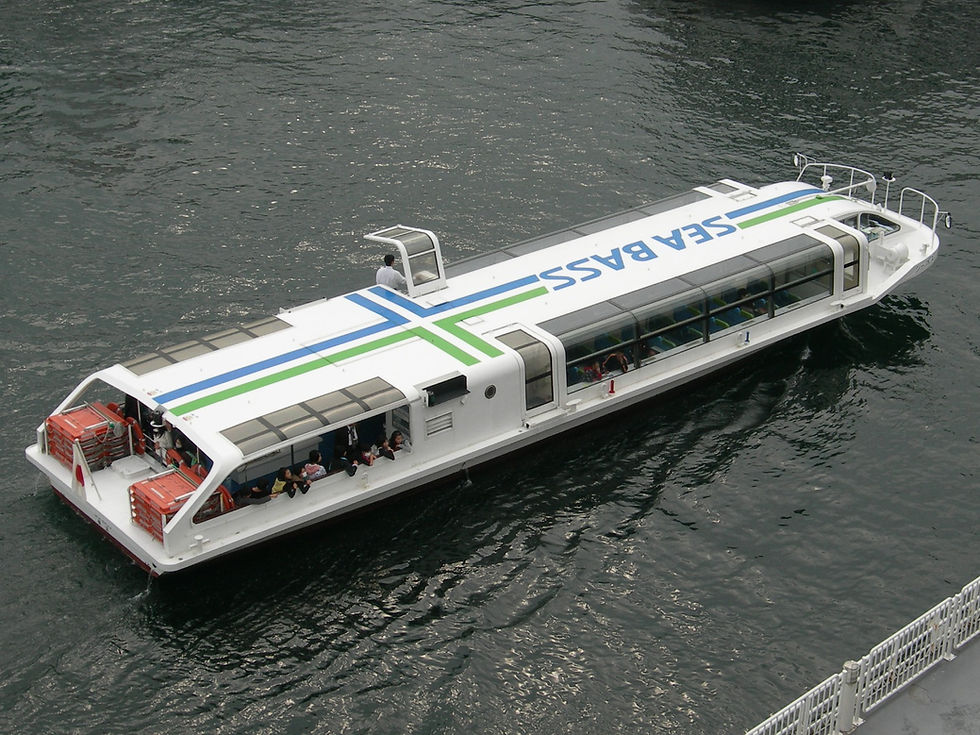
Yokohama Sea Bass seen from Hikawa Maru. Photo: Ogiyoshisan / Wikimedia Commons, CC BY-SA 3.0.
Between waterfront stops, the fare buys perspective more than speed
Hammerhead, Red Brick Warehouse and Yamashita Park are close enough that walking remains realistic. Short Sea Bass sectors cost roughly ¥1,000–¥1,300 for an adult, so they make most sense after you have already spent several hours on foot. A late-afternoon ride from Red Brick Warehouse to Yamashita Park gives the legs a break and redraws the shoreline from the water, but it should be treated as a scenic choice rather than a guaranteed time saver.

The timetable has skipped stops, direct runs and gaps that change the answer
Some published departures skip Pier Aka Renga; others skip Hammerhead, while selected weekend sailings run directly between Yokohama Station and Yamashita Park. Midday gaps can be much longer than a visitor expects from urban transport. The practical approach is to choose a dated departure first, then shape lunch or shopping around it. Arriving at a pier without checking the stop pattern can leave you waiting for a boat that does not serve the destination you planned.
Suitcases are manageable on board; finding the Yokohama Station pier is the real transfer
The Yokohama Station pier is on the second floor of Yokohama Bay Quarter, about five minutes from JR's North East Exit and closer to ten minutes from the main East Exit. The route is more comfortable than hauling luggage through another railway interchange once you find it, but it is not a platform beside the station gate. The boat is especially coherent when your hotel is near Minato Mirai, Red Brick Warehouse or Yamashita Park and the sailing becomes the final luggage movement of the day.

Yokohama Air Cabin and Minato Mirai waterfront. Source: Minato Mirai 21 official media.
Rain can strengthen the case; wind and an inflexible connection weaken it
The enclosed cabin makes an ordinary wet day easier than a long exposed waterfront walk, although photography and open-deck views lose some appeal. Wind and operating conditions matter more. The operator publishes daily service information and warns that final sailings may be cancelled. A fixed Shinkansen, airport transfer or restaurant booking with no margin belongs on the railway; a flexible sightseeing afternoon can absorb a changed sailing more easily.
Three itinerary shapes reveal whether the boat is transport or an attraction
Arriving in Yokohama for a harbour day: board at Yokohama Station and disembark at Red Brick Warehouse or Yamashita Park. Walking the waterfront in one direction: save the boat for the return and avoid retracing the promenade. Filling a short two-hour gap: rail is usually more dependable unless a direct sailing matches perfectly. Dinner in Chinatown favours a Yamashita Park arrival; an evening train back to Tokyo can make the reverse ride to Yokohama Station surprisingly tidy.
A blue-hour continuation route
Continue the waterfront after blue hour with The Yokohama Night Walk Most Visitors Miss: Air Cabin to Osanbashi at Blue Hour.
Related guides
Your hotel location can reverse the best sailing direction; compare Yokohama or Tokyo: Where Should You Stay for Two Nights?.
For a wet-weather alternative:
For a day when rain should reduce movement rather than multiply transfers, use Tokyo Rainy-Day Indoor Itinerary: Tokyo Station to Ginza Without Getting Soaked.
The Sea Bass rarely wins a spreadsheet based only on fare and minutes. Its advantage appears when the boat removes one more underground transfer, gives luggage a simpler direction and lets the city reveal its harbour before the next attraction begins. That is a narrower use case than "must-do cruise", but it is also a much more useful one.


Comments