
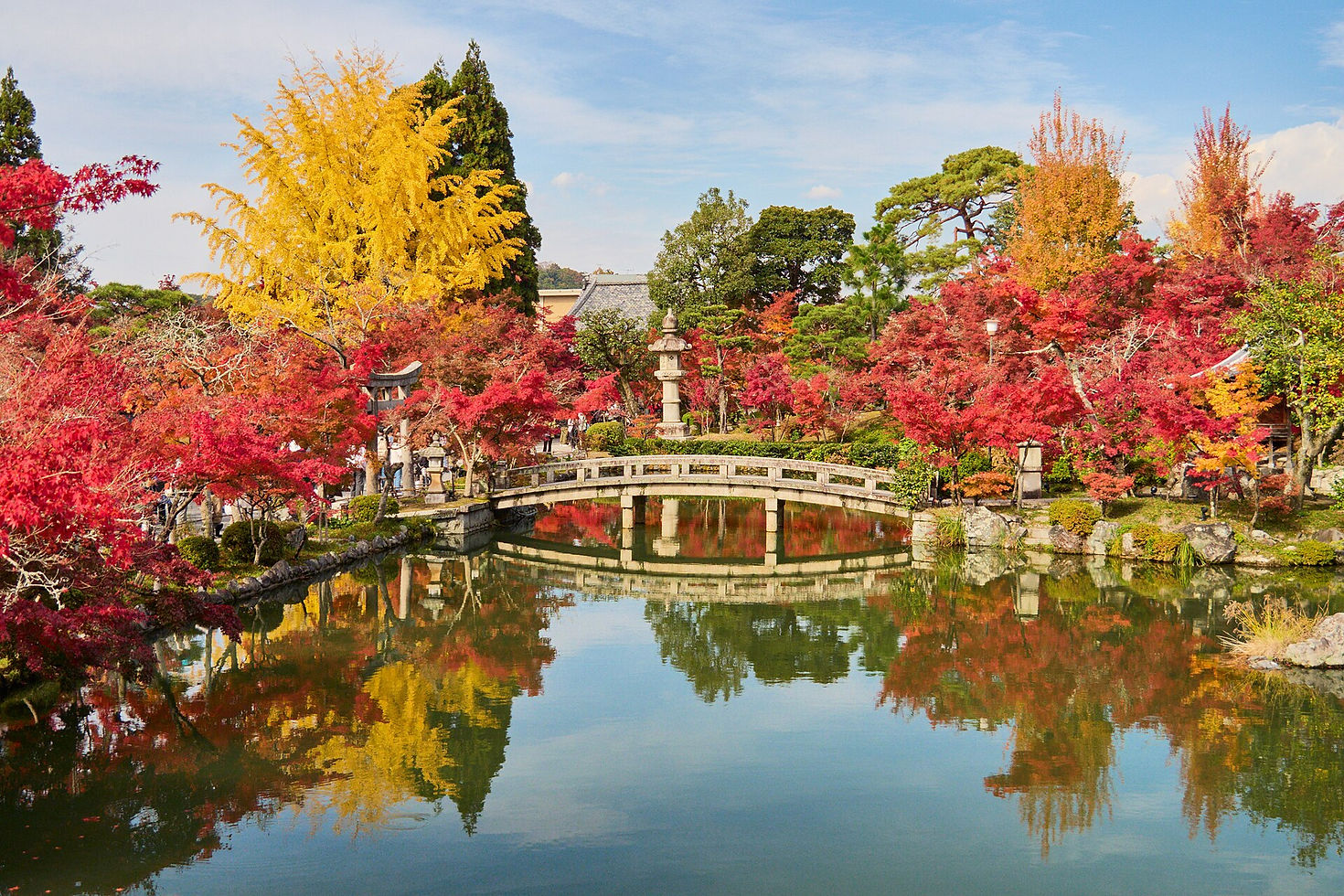
Kyoto Autumn Leaves Guide: Timing Map from Mountains to City
- cody
- 2 days ago
- 5 min read
The purpose of a Kyoto autumn leaves timing map is to answer which district deserves the first check for a given week, not to predict every tree. Northern valleys and mountain slopes usually change first, western foothills and Arashiyama often bridge the season, Higashiyama and Tofukuji become stronger later, and Uji, Daigoji or low city gardens can extend the final stage. Slope, sunlight, species, urban heat, night temperature, wind and rain create local reversals, so Kyoto is more useful as four foliage belts than as one citywide peak date.
Last checked August 4, 2026. Kyoto’s live 2026 foliage calendar was not yet in season; historical timing is planning context, not a formal forecast. Kiyomizudera has confirmed night viewing for November 21–30 and Toji’s current calendar lists October 31–December 13, but an event period is longer than peak colour. Every other temple’s 2026 ticket, clear-out and last-entry rules must remain pending until published.
Four foliage belts from mountain valleys to the basin
Belt 1 — Northern valleys and slopes: Mt Hiei, Takao, Kibune/Kurama, Ohara and Yase; check from late October into early November.
Belt 2 — Western foothills: Arashiyama, Okusaga, Nishiyama and Oharano; commonly bridges early and mid-November.
Belt 3 — Higashiyama and southern temples: Nanzenji, Eikando, Kiyomizudera and Tofukuji; often central in mid-to-late November.
Belt 4 — Late lowland colour: Uji, Daigoji, central gardens and some ginkgo; useful from late November into early December.
The belts do not move downhill on a perfect schedule. Arashiyama combines mountain slopes, riverbanks and temple gardens, and northern and southern Higashiyama can differ. Choose two adjacent candidates from the date, then decide the previous evening with dated official photographs and transport. The map is not permission to cross all four belts in one day.

Late October to November 10: mountain Kyoto is the main search area
Check Mt Hiei, Takao, Kibune/Kurama, Ohara and Yase first. Takao uses JR to Enmachi plus a final bus or another official access route; Jingoji’s long stairs make it unsuitable for every older traveller. Eizan Railway forms the rail spine for Kibune and Kurama, but Kibune still needs a bus and the Kurama traverse is a hike. Ohara is more controllable through the subway and a final bus, with moss and temples providing value even before full colour. Do not advertise a lower-crowd early trip as guaranteed peak foliage when central Kyoto remains green.
Takao: earlier temples with a stair and bus cost
Takao suits travellers willing to give the full day to mountain temples, photography and bus timing. Jingoji’s approach can consume the physical capacity needed for a second temple; a Kozanji or Saimyoji short version is more realistic for limited knees. When strong wind has already removed mountain colour, do not spend several hours commuting only to complete the planned list. Switch the previous evening to Arashiyama or Nishiyama, not after arriving in the valley.

Kibune, Kurama and Ohara share a region, not an effort level
Kibune combines a shrine, valley road and Eizan access with moderate effort, but bus capacity, narrow walking space and stairs need a buffer. Kurama’s main hall already requires uphill travel, and the route over roots and steps to Kibune is a genuine trail; rain, early darkness, closures or wildlife notices cancel it. Ohara has gentler gradients and a practical Sanzenin-plus-one-temple structure for families and older travellers. Being in northern Kyoto does not make these three places compatible in one day.
November 11–20: Arashiyama and Higashiyama begin taking over
This is where a citywide timing assumption fails most often. Arashiyama and Nishiyama may develop visible mountain colour while northern Higashiyama strengthens through Nanzenji, Eikando and the Philosopher’s Path; the mountains can still retain a tail. Use JR, Hankyu or Randen for Arashiyama and the Tozai Subway to Keage for northern Higashiyama. Both districts need an early start and a crowd buffer, so they are poor deep-visit partners on the same day.
Arashiyama contains several foliage clocks
Togetsukyo reflects slopes and river scenery, Tenryuji is a managed garden, and Okusaga has different shade and species. A photograph of the mountains cannot prove that the temple garden is at peak. A first visit can combine an opening-time temple, the bridge and one Okusaga stop. Photographers should choose between landscape, garden and quiet morning light instead of repeatedly crossing the crowded centre in an attempt to collect every version.
Northern and southern Higashiyama require separate route logic
Northern Higashiyama uses Keage, Nanzenji, Eikando and the Philosopher’s Path, with subway access and the option to shorten in rain. Southern Higashiyama uses Kiyomizudera, Kodaiji, Yasaka and Gion, with steeper stone streets and heavier midday crowds. Each can fill a day. An evening event belongs on the same district day only after the 2026 rules are confirmed and after allowing for a clear-out, early dinner and a rail-first return.

November 21–30: the problem becomes choice, not availability
Tofukuji, Higashiyama, lower Arashiyama and Uji can all be viable, creating pressure rather than scarcity. Enter Tofukuji early and continue to either a short Fushimi Inari visit or Uji. In southern Higashiyama, place the Kiyomizudera slopes in the morning and keep the afternoon local. Uji and Daigoji become stronger late-season options because tea, architecture and river scenery reduce the cost of imperfect leaves. Retain northern mountains only when current dated images still show colour.

Read live foliage, not a generic peak label
Check the photograph date, update time and exact sub-area. Separate close maple trees, mixed mountain woodland, ginkgo and fallen-leaf ground colour. Review the previous 48 hours for strong wind, rain or sudden cooling; a two-day-old peak image may be obsolete after a storm. Keep one higher and one lower candidate, but every switch must include first and final services, bus capacity, walking, sunset and prepaid tickets. Better colour without feasible transport is not a usable backup.
Rail first, bus only for the final segment
Kyoto’s official guidance recommends using trains close to the destination and buses or walking for the final stretch. Use subway and Keihan for Higashiyama, JR/Hankyu/Randen for Arashiyama, JR Nara or Keihan for Tofukuji and Uji, and Eizan Railway for Kibune/Kurama. Takao and Ohara remain bus-dependent at the end. The city-bus flat fare is ¥230 in the central zone; the 2026 Subway & Bus 1-Day Pass is ¥1,100, but suburban sections and private railways have separate coverage. Most foliage visitors do not need a rental car, and Kyoto specifically asks travellers to avoid driving in the crowded autumn season.
Hotel bases create or destroy late changes
Kyoto Station supports Tofukuji, Uji, Arashiyama, intercity rail and luggage. Kawaramachi/Gion supports Higashiyama, Keihan, Hankyu, dining and evening walking. Karasuma Oike offers the strongest multi-direction flexibility through both subway lines and suits travellers who do not yet know whether the season is early or late. Demachiyanagi shortens Kibune, Kurama and Ohara but offers fewer hotels and late meals. Otsu can solve a Kyoto sell-out, but an illumination requires a protected final train. Named hotels are examples only; availability, room size and cancellation must be checked for the actual date.
Kyoto foliage Plan B
If the trip is early, check Takao, Kibune, Ohara and Mt Hiei rather than assuming Higashiyama is red. If the mountains have finished, move downhill to Arashiyama, Higashiyama, Tofukuji, Uji and city gardens. Heavy rain removes the Kurama trail, Jingoji’s long stairs and a full Philosopher’s Path. Full buses favour boarding near the origin, deleting a second sight or changing to rail. A pending or sold-out illumination becomes dinner and a public nightscape, followed by an opening-time daytime visit.
Frequently asked questions
What month is usually best?
Mid-to-late November is the usual city core; mountains are earlier and some lowland colour continues into early December.
Can Arashiyama and Higashiyama fit in one day?
Not as deep visits. Both require early time, crowd buffers and substantial walking.
Does an illumination date mean peak foliage?
No. Event periods are longer than peak colour and never replace current reports.
Next planning steps and official sources
Information last checked August 4, 2026. Foliage, events, transport, passes and temporary restrictions must be reconfirmed for the travel date.

