
The Dancing Ends at 8 PM. Your Koenji Awa Odori Exit Plan Should Start Before It Does
- Iris

- 3 days ago
- 4 min read
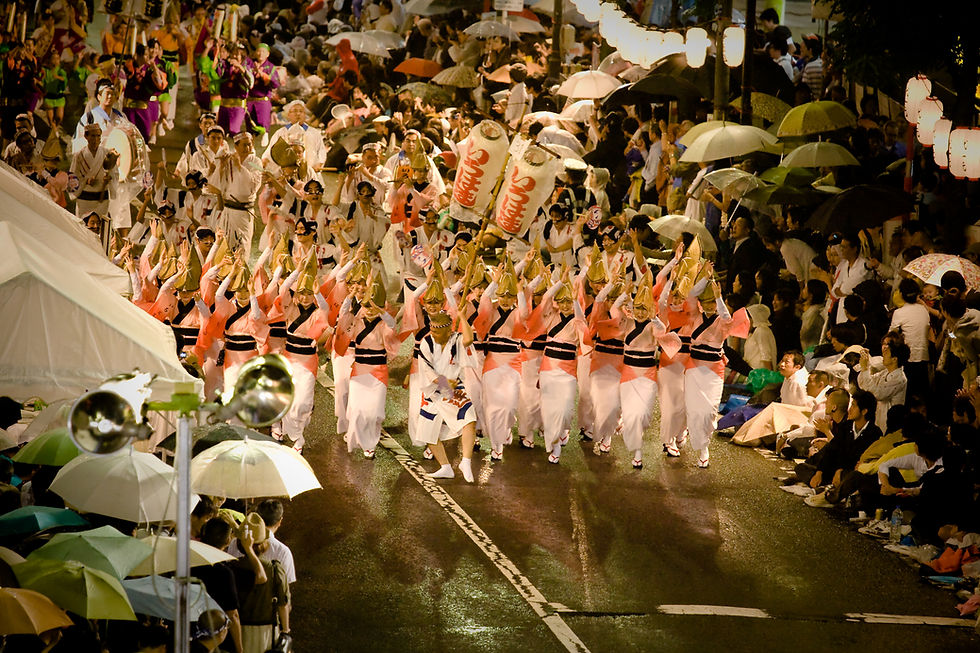
Koenji Awa Odori exit transport becomes difficult because eight street performance areas finish around the same time, not because either station is especially far away. The 67th Tokyo Koenji Awa Odori is confirmed for August 29–30, 2026, with street dancing from 5:00 PM to 8:00 PM and traffic controls from 4:10 PM to 8:30 PM. Waiting until the final troupe has passed before choosing a railway usually means joining the largest possible crowd with no clear direction.

The practical answer is simple. Travellers heading toward Shinjuku, central Tokyo or the Marunouchi Line should not automatically follow everyone to JR Koenji Station; Shin-koenji can be the cleaner exit when the final viewing point is already on the southern side. Travellers heading west toward Kichijoji or Mitaka should usually keep JR Koenji, but move toward the station side before 8 PM or wait in the neighbourhood until the first surge has eased.
Koenji Awa Odori exit transport starts with your direction home
For Shinjuku, Tokyo Station connections and destinations along the Marunouchi Line, the shortest walk is not always the fastest journey. Shin-koenji Station sits south of the festival area and suits people finishing near Konan-dori or the Look performance areas. Walking with the southbound flow is usually easier than crossing back through the most compressed streets around JR Koenji.
For Nakano, Kichijoji, Mitaka and other points west on the Chuo Line, JR Koenji remains the direct choice. Diverting to Shin-koenji and changing again at Shinjuku can erase any advantage gained by avoiding the first queue. Place the final viewing point near the central or northern performance areas and begin edging toward the planned entrance before the closing minute.
Stay for the final dance or start moving at 7:40 PM?
Staying until the final beat makes sense for a first visit, for travellers who value the complete atmosphere and for anyone without an early start the next day. It also means accepting the 8 PM crowd. A plan that says “watch everything” and “be on a train ten minutes later” is not a plan; the two goals conflict.
Starting the exit at about 7:40 PM does not mean abandoning the festival. It means watching the last section while moving toward the correct side. This is the stronger choice for families, older travellers, anyone who cannot stand for long and people with an important connection. The value of twenty minutes is not a guaranteed empty station. It is being on the useful side before the final crowd reorganises the streets.
Do not cross the entire festival after the finish
The eight performance areas stretch between JR Koenji and Shin-koenji, with narrow shopping streets, wider roads and different crowd flows. A common mistake is finishing north of the station and then deciding to use Shin-koenji, or finishing in the south before pushing back toward JR. That adds distance at exactly the moment when lateral movement is hardest.
Decide the final station first, then choose the final performance area. Earlier in the evening you can explore more widely. During the final hour, treat the neighbourhood as a one-way plan: each move should bring you closer to the railway or waiting place you have already chosen.
Families, older travellers and large luggage
Large suitcases should be left at accommodation, a major-station locker or staffed luggage storage before entering the core streets. Traffic controls and stop-start pedestrian flow make wheeled luggage awkward and potentially obstructive. When luggage cannot be avoided, stay on the outer edge near the final station and give up the idea of crossing the festival at peak time.
Families and older travellers should treat 7:30–7:40 PM as a decision point. Begin moving while toilets, water and rest are still manageable. When fatigue has already arrived, eating nearby and leaving after the 8:30 PM traffic-control window can be calmer than standing in a station-entry queue with no flexibility.

Rain, disruption and a realistic Plan B
Rain concentrates people under shopping arcades and around station entrances while slowing the whole street. On a wet evening, move at least twenty minutes earlier and avoid opening a long umbrella inside dense flows. A rain jacket or compact umbrella is easier to manage.
If the Chuo Line is delayed, do not automatically join the biggest JR queue. Check live railway information, then choose between Shin-koenji, waiting locally or adjusting the onward route. If the Marunouchi Line has the disruption, the reverse applies. A useful Plan B preserves access to two different rail systems instead of memorising one alternative street.
Related reading
Choose your Koenji Awa Odori exit transport plan
Going west on the Chuo Line and avoiding extra changes: use JR Koenji, but move toward the station side before 7:40 PM. Going toward Shinjuku, central Tokyo or the Marunouchi Line and willing to walk farther for a more distributed flow: finish in the south and use Shin-koenji. Travelling with children, older relatives or limited stamina: leave twenty to thirty minutes before the finish. No hard deadline: have dinner in Koenji and let the 8:00–8:30 PM surge pass.
Before travelling, recheck the official festival page, the current traffic-control map and live railway status. The strongest exit plan is decided before entering the crowd, with the final viewing area already matched to the journey home.


Comments