
Saga Without a Car: Yutoku Inari, Ouo Sea Torii (Tides), Kaidomaru BBQ & Karatsu Kunchi
- Cody Tse
- Dec 18, 2025
- 6 min read

Updated: Dec 21, 2025
Yutoku Inari Shrine → Ouo Shrine’s Sea Torii → Kaidomaru Seafood BBQ → Karatsu Kunchi Festival (No-Car, Real-World Travel Diary)

A no-car travel diary from my working-holiday days in Japan: a day and a half from Fukuoka into Saga—Yutoku Inari Shrine’s striking vermilion “floating” hall, Ouo Shrine’s three sea torii that transform with the tide, a standout seafood BBQ lunch at Kaidomaru, and an unforgettable night at Karatsu Kunchi (Karatsu’s autumn festival). Honest notes on slow transport, tide timing (morning/evening high tide vs midday/early afternoon low tide), festival crowds, and what I wish I had prepared.
Quick Navigation
Stop 1: Yutoku Inari Shrine — A vermilion stage on the mountainside
Stop 2: Ouo Shrine Sea Torii — Three gates, two completely different worlds
Lunch: Kaidomaru — The “reset button” you need on a no-car day
Karatsu Kunchi: My first major Japanese festival—and it taught me about “exit strategy”
What I’d do differently next time (no-car survival checklist)
Why Saga is worth the trouble
Saga isn’t a place that wins by convenience. It wins by quiet.Once you leave the city rhythm of Fukuoka, the “volume” drops: fewer people, wider skies, calmer roads, and a coastline that changes personality with the tide. The trade-off is unavoidable if you don’t drive: limited service frequency, tight transfers, and the constant sense that one missed connection can rewrite your day.
If you accept that friction upfront, Saga becomes unusually rewarding—especially if you like slow travel, open scenery, and moments that feel unplanned in the best way.
Stop 1: Yutoku Inari Shrine — A vermilion stage on the mountainside


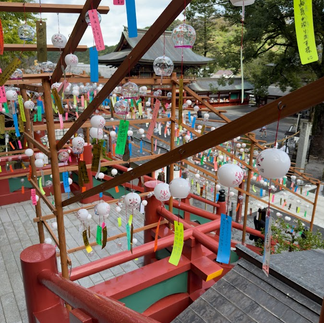


My first stop was Yutoku Inari Shrine. It’s not the kind of place that overwhelms you with size. What makes it memorable is its architecture.
The main hall is built into the slope and lifted on pillars, creating a dramatic, almost theatrical silhouette—like a vermilion stage perched above the trees. From below, the stairs and railings naturally pull your eyes upward, and the structure feels beautifully layered rather than simply “big.”
A light touch of history helps frame it: the shrine dates back to the late 17th century and is dedicated to Inari, a widely worshipped deity associated with prosperity and everyday protection. That’s why you’ll see visitors praying for business, work, and household blessings—practical hopes, not abstract ones.
How it feels (and why it photographs well):
The visual impact comes from structure + color + elevation, not crowd spectacle.
Compared with ultra-famous Inari spots in larger cities, it can feel easier to find clean angles—less “pushed” by foot traffic.
The best look is often from a lower vantage point, letting the lines of stairs and railings guide the frame toward the vermilion hall.
Stop 2: Ouo Shrine Sea Torii — Three gates, two completely different worlds


From Yutoku Inari, I headed toward Ouo Shrine (often visited for its three sea torii). This is where the journey shifts into full rural mode: fewer connections, longer waits, and more dependence on timing.
But once you arrive, the payoff is immediate—because the star here isn’t the torii themselves. It’s the tide.
Three torii stand in a line stretching from the shoreline into the tidal flats. And the scene changes so dramatically that it feels like two separate destinations:
What you’ll see
High tide: the water rises and the torii look like they’re floating—minimal, clean, almost surreal.
Low tide: the seabed reveals itself, and you can walk closer across the flats. The mood turns wide, quiet, and grounding—more texture, more space, more silence.
Tide timing (simple, practical, not minute-by-minute)
If you just want a reliable rule of thumb:
Low tide (walk closer / exposed flats): often falls around midday to early afternoon on many days.
High tide (floating torii look): often shows up in the morning or late afternoon to evening on many days.
The tide shifts daily, so I wouldn’t memorize a schedule. I’d simply check a tide forecast the same morning and decide what kind of scene you want: close-up texture (low tide) or floating minimalism (high tide).
Lunch: Kaidomaru — The “reset button” you need on a no-car day


After the sea torii, I ate at Kaidomaru, a seafood BBQ spot nearby. On a no-car trip, the real cost isn’t just time—it’s patience. Waiting, transferring, second-guessing directions… it adds up. A genuinely satisfying meal can restore the entire day.
What stood out most:
The grilled seafood felt fresh and direct—especially whelk-like shellfish and scallop-style bites (the kind that taste sweet, juicy, and clean).
The owner was remarkably welcoming. Even without strong Japanese, communication was possible through gestures and phone translation. In small towns, that willingness to meet you halfway matters more than people realize.
Tara Station: No signal, one question, and a friendship I didn’t plan
After lunch, I went to Tara Station to head toward Karatsu for the festival. At that moment, my phone data simply stopped working. With no signal, even basic decisions—like which platform direction was correct—felt risky.
So I asked the Japanese woman sitting next to me. We used translation apps, and the conversation naturally turned into a friendship. Then came the kind of coincidence that only happens in places like this: she worked at the very restaurant I had just visited, and she was connected to the staff there.
It was a small reminder that rural travel doesn’t always reward you with convenience—but it often rewards you with human moments.
Karatsu Kunchi: My first major Japanese festival—and it taught me about “exit strategy”

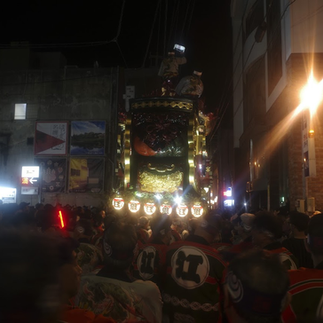


By the time I reached Karatsu, the energy was the opposite of Saga’s quiet: dense crowds, stalls, noise, movement, and a surprising mix of visitors from many countries. This was my first large-scale festival experience in Japan, and it was intense in the best way.
Karatsu Kunchi is typically held November 2–4 each year. It’s known for massive festival floats and a city-wide momentum that feels less like “an event” and more like a living machine.
The part nobody warns you about: leaving
I planned to return to Fukuoka the same night and didn’t book a hotel. That was my mistake.
The crowd volume slowed everything down: walking back to the station, navigating streets, figuring out where the flow was going. Add the fact that the most exciting festival atmosphere often peaks later, and suddenly “the last train” becomes an abstract idea, not a realistic plan.
I ended up booking a room last-minute. Of course, with my phone still unreliable, I needed Wi-Fi. I asked a group of Japanese girls nearby, borrowed Wi-Fi, and—again—ended up making friends and watching parts of the festival together.
That night made one lesson painfully clear:At big festivals, the real planning question isn’t “How do I get there?” It’s “How do I leave safely and smoothly?”
Day 2: A calmer morning, then back to Fukuoka


I stayed overnight, watched the morning atmosphere the next day, and returned to Fukuoka. The contrast was perfect: the night was pure heat and motion; the next morning felt like the city exhaling.
What I’d do differently next time (no-car survival checklist)
Download offline maps before you leave. No signal turns small choices into stressful ones.
Check tide timing the same morning for the sea torii:
low tide often midday/early afternoon, high tide often morning/evening (varies by day).
Build buffer time into every transfer. Saga punishes tight schedules.
Festival day = have a lodging backup. Even if you intend to return, assume crowds can change the outcome.
Carry a reliable power bank. Translation + maps + booking under pressure drains battery fast.
Closing thought
Saga won’t try to impress you with ease. It asks for patience, time, and flexibility—especially without a car. But if you can pay that price, it pays you back with something rare: quiet landscapes, slow roads, and unexpected kindness that becomes the part you remember most.
Read More:
Fukuoka Local’s Route 210 Road Trip: 6 Hidden Stops to Yufuin (Shrines, Views & Anime Spots)
Huis Ten Bosch Fireworks in Nagasaki: A Field-Tested Kyushu Fireworks Festival Guide
Beppu Hells (Jigoku Meguri) 2 Days 1 Night Itinerary: The Ultimate Hot Spring “Steam City” Guide
Saga Without a Car: Yutoku Inari, Ouo Sea Torii (Tides), Kaidomaru BBQ & Karatsu Kunchi


